Cart
0

The label isn't confusing by accident
You pick up a sunscreen bottle, flip it over, and suddenly you're staring at a wall of chemical names. Oxybenzone-free. Transparent zinc oxide. Octinoxate-free. Broad spectrum SPF 38. It's a lot — and most of us just squint, shrug, and grab the one with the highest SPF number.
That's not a great strategy. The number tells you how much protection you're getting; the ingredient panel tells you how you're getting it, and that difference matters a lot depending on your skin type, your activity, and what you're comfortable putting on your body. Once you understand the two basic categories of sunscreen filters, every other label term clicks into place.
The core difference: where does the protection happen?
All sunscreens block UV radiation, but they do it through two fundamentally different mechanisms.
Mineral sunscreens use physical filters — most commonly zinc oxide and/or titanium dioxide — that sit on top of the skin and scatter or reflect UV rays before they can penetrate. They start working as soon as they're applied. Zinc oxide in particular covers both UVA and UVB wavelengths, which is why you'll see it in broad spectrum formulas.
Chemical sunscreens use organic (carbon-based) filter molecules — ingredients like avobenzone, homosalate, octisalate, and octocrylene — that absorb UV radiation and convert it to a small amount of heat, which dissipates from the skin. Chemical formulas typically need about 15 to 20 minutes after application before they're fully active.
That's the whole foundation. Everything else on the label is a refinement of one of those two approaches.
Reading the label on a real mineral sunscreen: Solbar Zinc SPF 38
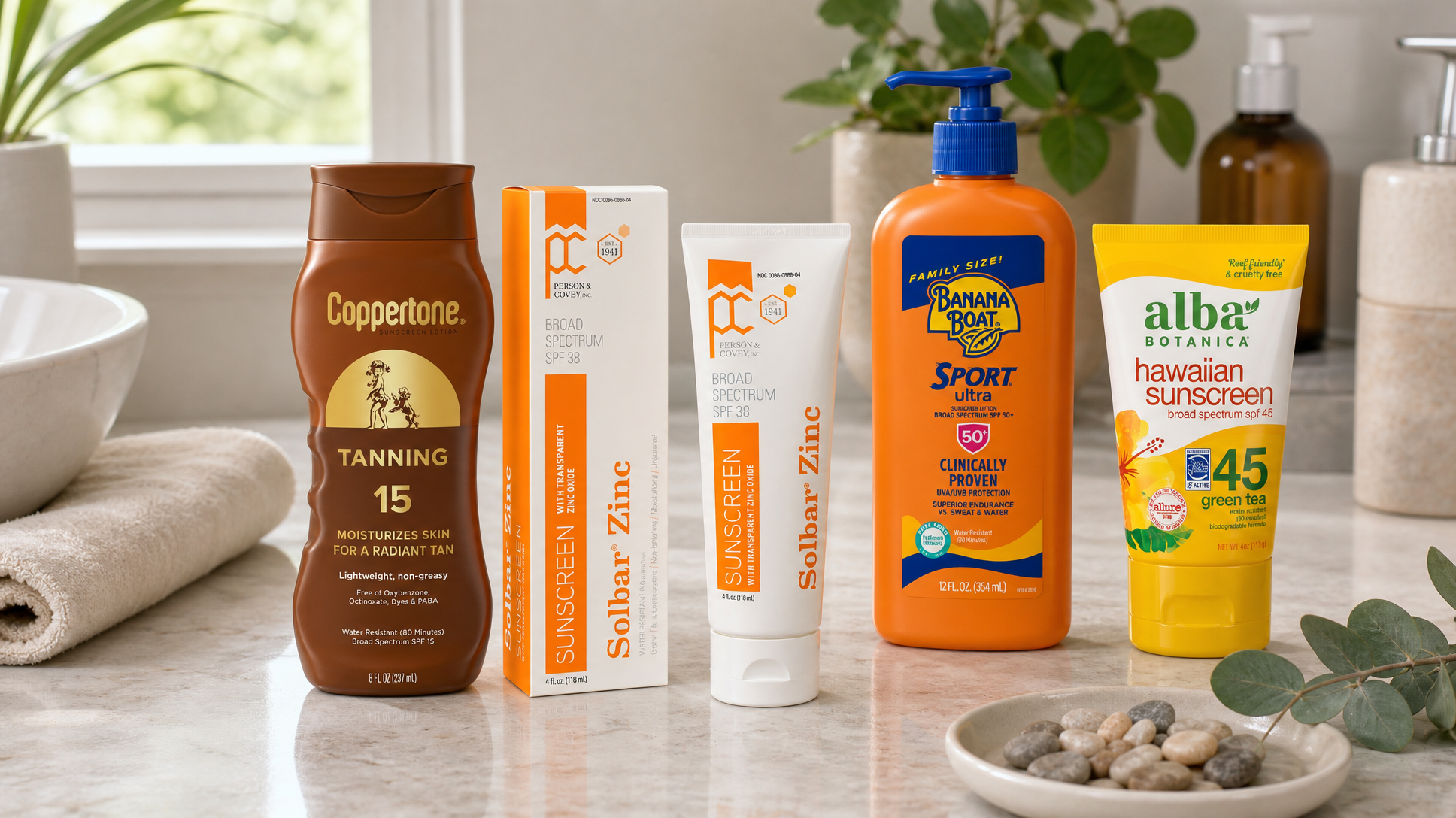
The Solbar Sunscreen Zinc Unscented Transparent Cream SPF 38 is a clean example of a mineral formula done well. The white squeeze tube from Person & Covey comes with a matching box — both in a bright white-and-orange design — and the label tells you quite a bit if you know what to look for.
"With Transparent Zinc Oxide" — this is the active ingredient doing the UV work. The word "transparent" is doing real work here too: traditional zinc oxide formulas left a white cast, which is why lifeguards in old photos had white noses. Micronized or nano-particle zinc oxide formulas are formulated to go on more invisibly. If a white cast is a dealbreaker for you, "transparent" on the label is the flag to look for.
"Non-Comedogenic" — means the formula is designed not to clog pores. For anyone who's ever broken out from a heavy sunscreen, this matters. Mineral formulas in general tend to sit on the skin rather than sinking in, but a non-comedogenic designation means the specific formulation has been developed with pore-clogging in mind.
"Non-Irritating" — zinc oxide is well-tolerated by sensitive skin, and Solbar calls this out directly. If your skin reacts to fragrances or certain chemical filters, a fragrance-free, zinc-based formula is often the first recommendation from dermatologists.
"Unscented" — no added fragrance, which reduces the irritation risk further.
"Water Resistant 80 Minutes" — this is an FDA-regulated claim. Sunscreens can only state "water resistant" if they've been tested and maintain their SPF for either 40 or 80 minutes of water exposure. Solbar Zinc claims the full 80 minutes.
"Moisturizing" and "Cream" — tells you the texture and that there's a moisturizing component to the formula, which is useful for dry skin types.
Reading the label on a real chemical sunscreen: Banana Boat Sport Ultra SPF 50+
The Banana Boat Sport Ultra SPF 50 Sunscreen Lotion is a high-SPF chemical formula in a large orange pump bottle — the kind built for activity. Here's what the label is signaling.
"SPF 50+" — SPF 50 blocks roughly 98% of UVB rays when applied correctly. The "+" indicates the formula tested above 50 in lab conditions. Higher SPF matters most when you're outdoors for extended periods.
"Oxybenzone Free" — this is a notable call-out. Oxybenzone is a chemical UV filter that has faced scrutiny over potential hormone-disruption concerns and has been flagged as harmful to coral reef ecosystems. Banana Boat Sport Ultra specifically removes it from this formula. It still uses other chemical filters to achieve SPF 50+ protection — it's not a mineral formula — but for shoppers who want to avoid oxybenzone specifically, this label term is meaningful.
"Broad Spectrum" — an FDA-regulated term confirming the formula protects against both UVA (aging, deeper penetration) and UVB (burning) rays. Any sunscreen without this designation only protects against UVB.
"Clinically Proven UVA/UVB Protection" — reinforces the broad spectrum claim with a testing reference.
"Superior Endurance vs. Sweat & Water" and "Water Resistant (80 Minutes)" — again, that 80-minute regulated claim. For a sport formula, this is essential; it's the reason this type of product exists.
"Sunscreen Lotion" — chemical formulas tend to be lighter and easier to spread across large body areas, which is why they dominate sport and family-size formats. The pump bottle reinforces the idea that you're going to use a lot of it, quickly.
The two other products in this mix — and where they sit
The Coppertone Tanning Sunscreen Lotion SPF 15 takes a different approach entirely. It's a chemical-filter formula at a lower SPF, designed not to block tanning but to allow it while providing a baseline of broad spectrum protection. The label says "Moisturizes Skin for a Radiant Tan" and is free of oxybenzone, octinoxate, dyes, and PABA — a longer list of removed ingredients than you'd expect. It's water resistant for 80 minutes and comes in a lightweight, non-greasy formula. SPF 15 is the minimum the American Academy of Dermatology recommends for daily use; if you're spending serious time in the sun, it's on the lower end. But if your goal is a tan with some protection rather than full blockade, it's honest about that trade-off.
The Alba Botanica Hawaiian Sunscreen SPF 45 Green Tea sits between the two extremes — SPF 45, broad spectrum, water resistant for 80 minutes, reef friendly, and cruelty free. It's a biodegradable formula, which is the claim that matters for ocean-conscious shoppers. The green tea extract is a skincare ingredient rather than a UV filter, but it signals that the brand is thinking about the formula beyond just sun protection. It also carries an Allure award badge on the packaging, which is a third-party editorial recognition.
So which type should you actually use?
There's no single right answer, but there are clear patterns.
Reach for a mineral formula (like Solbar Zinc SPF 38) if you have sensitive or acne-prone skin, if you're applying sunscreen to children or people with reactive skin, or if you want to avoid chemical UV filters entirely. The trade-off is that zinc-based creams can be thicker and require more blending, though transparent formulas have narrowed that gap considerably.
Reach for a chemical formula (like Banana Boat Sport Ultra SPF 50+) if you want a lighter texture that spreads easily over a large area, if you're sweating heavily during sport, or if you need high SPF coverage without a white cast. Just remember to apply it about 15-20 minutes before sun exposure so the filters have time to activate.
SPF 15 tanning formulas are a niche choice — they're honest about their purpose, but they're not substitutes for full sun protection if you're out for hours.
Reef-friendly and biodegradable formulas are worth seeking out if you're swimming in the ocean, regardless of whether you prefer mineral or chemical filters.
And one rule that applies across every category: reapply every two hours, or immediately after toweling off. No SPF number keeps working if you don't reapply.
Ready to shop with a clearer head? Browse sunscreen and skincare options at Feelforever21 — free shipping on every order across the USA.
For more on building a skin-protective routine, the expert-backed guide to building an effective skincare routine covers how sunscreen fits into the bigger picture.
Frequently Asked Questions
Is mineral sunscreen actually better than chemical sunscreen?
Neither is objectively better — they're different tools. Mineral sunscreens (zinc oxide, titanium dioxide) are generally better for sensitive or acne-prone skin and start working immediately on application. Chemical sunscreens tend to be lighter, easier to spread over large areas, and are popular for sport use. The best sunscreen is the one you'll actually apply consistently and reapply every two hours.
What does "oxybenzone free" actually mean on a sunscreen label?
It means the formula doesn't contain oxybenzone, a chemical UV filter that has been associated with concerns about hormone disruption and coral reef damage. Oxybenzone-free sunscreens still use other chemical filters to provide UV protection — removing oxybenzone doesn't make a sunscreen mineral. If avoiding oxybenzone specifically is a priority for you, look for that label call-out, as the Banana Boat Sport Ultra SPF 50+ does.
Does "water resistant 80 minutes" mean I don't need to reapply after swimming?
No. "Water resistant 80 minutes" means the formula maintains its stated SPF for up to 80 minutes of water exposure in lab testing — but once you towel off, that protection is largely removed with the product. The general guidance is to reapply immediately after toweling off, and at least every two hours regardless of water activity.
What SPF should I use for everyday wear versus a day at the beach?
For daily incidental sun exposure — commuting, running errands — SPF 15 to 30 is commonly recommended as a baseline. For extended outdoor time, swimming, or high-altitude activities where UV exposure is significantly higher, SPF 30 to 50+ is more appropriate. The key variable isn't just the number but how much you apply and whether you reapply — an SPF 50 that's applied too thinly or not reapplied will underperform an SPF 30 used correctly.