Cart
0
Fine hair is one of those things that sounds like a minor inconvenience until you're standing in the shower holding a conditioner that promises 'intense moisture' and wondering why your hair looks flatter by noon. Most hair care advice assumes you're fighting frizz or dryness. If your hair is fine, your problem is almost the opposite — and a lot of standard advice is actively making it worse.
Here's what actually helps.
First, Understand What 'Fine' Actually Means
Fine hair refers to the diameter of each individual strand — not how much hair you have. You can have a full head of fine hair or thin coverage with coarse strands. This distinction matters because the whole strategy changes. Fine strands have a smaller cuticle surface, which means they absorb product quickly, weigh down fast, and lose volume before lunch if you use too much of anything.
The goal isn't to make fine hair behave like thick hair. It's to work with what you have — and stop fighting it with products designed for someone else's hair type.
What You're Washing With Matters More Than How Often
The 'wash less often' advice gets repeated constantly for fine hair, and it's only half right. Yes, over-washing can strip natural oils and cause your scalp to overcompensate. But letting oil and product build up on fine strands is just as damaging — it weighs them down and makes them look limp and greasy within hours.
The real answer: wash when your scalp needs it, but choose a shampoo that actually cleans without loading strands with heavy conditioning agents. Look for lightweight, clarifying, or cleansing formulas rather than anything labeled 'moisturizing' or 'smoothing' — those tend to coat fine hair and flatten it out. A cleansing oil shampoo, like the Ouidad Ultra-Nourishing Cleansing Oil Shampoo, is worth considering if your scalp needs a thorough clean without the stripping effect of harsh sulfates.
Whatever you use, concentrate shampoo at the scalp and roots — not the lengths. The mid-shaft and ends don't need the same deep clean, and lathering them repeatedly leads to unnecessary dryness and breakage.
The Conditioner Trap (and How to Avoid It)
This is where most fine-haired routines fall apart. Conditioner is not optional — your ends still need moisture and protection — but the way you apply it makes all the difference.
- Never apply conditioner to your roots. Start at mid-shaft and work down to the ends only. Roots don't need conditioning, and getting product there is the fastest route to flat, greasy hair by mid-morning.
- Rinse thoroughly — then rinse again. Conditioner residue left on fine strands shows up immediately as limpness and dullness.
- Choose lightweight formulas. Anything described as 'rich', 'deep', or 'ultra-moisturizing' is almost certainly too heavy for fine hair on a regular basis. Save those for an occasional treatment on your ends only.
If you're struggling to find the right balance, our guide to choosing the right conditioner for your hair type breaks down ingredients and formulas in more detail.
Treatments to Skip (or Use Sparingly)
Fine hair doesn't mean damaged hair — and treating it like it's damaged is one of the most common mistakes. Here's what to pull back on:
Heavy masks and deep conditioners. These are formulated for coarse, dry, or chemically treated hair. On fine hair, they tend to coat the strand and collapse volume. If you do use one, apply it only to the last inch or two of your ends, leave it on for a shorter time than the label suggests, and rinse very well.
Leave-in conditioners with heavy oils or butters. Ingredients like shea butter and coconut oil are brilliant for thick or coarse hair but can be too dense for fine strands. If you want a leave-in, look for a lightweight mist or spray formula rather than a cream. Our guide to leave-in conditioners covers which formulas suit different hair types.
Layering too many products. Fine hair shows product buildup faster than any other hair type. If you're using a pre-wash oil, a conditioner, a leave-in, a heat protectant, and a finishing spray — that's almost certainly too much. Pick two or three and commit.
Heat and Fine Hair: A Practical Truce
Fine hair is more vulnerable to heat damage than thicker hair types because there's less structural mass in each strand to absorb and dissipate heat. That doesn't mean you can never use a blow dryer or flat iron — it means you need to be deliberate about it.
- Always use a heat protectant before any hot tool, even a diffuser.
- Blow dry on a medium heat setting rather than the highest — fine hair dries quickly and doesn't need aggressive heat.
- Avoid repeated passes with a flat iron over the same section. One clean pass at the right temperature is better than three passes at a lower one.
If you're air drying, avoid touching or scrunching your hair while it's wet — fine strands are at their most fragile when saturated, and too much manipulation leads to frizz and breakage.
The Scalp Is the Foundation
Fine hair and scalp health are more connected than most people realize. An oily or congested scalp makes fine hair look flat and greasy faster. A dry, irritated scalp leads to flaking that shows up clearly on fine strands. Either way, the scalp is where the routine starts — not the ends.
A gentle scalp massage during shampooing improves circulation and helps loosen buildup without over-stimulating oil production. If you're dealing with persistent oiliness or dandruff, look at targeted scalp treatments rather than just changing your shampoo — the problem is usually at the root, literally.
Build the Routine Around Your Hair, Not the Trend
The most effective fine-hair routine is a simple one: a proper cleansing shampoo used at the scalp, a lightweight conditioner applied only to the ends, minimal product layering, and heat protection when you need it. That's it. No weekly mask, no scalp oil, no 10-step process.
The temptation is always to add more — more products, more steps, more treatments. Fine hair usually needs less, not more. The brands that understand this tend to formulate specifically for the hair type rather than just slapping 'volumizing' on the label of a standard formula.
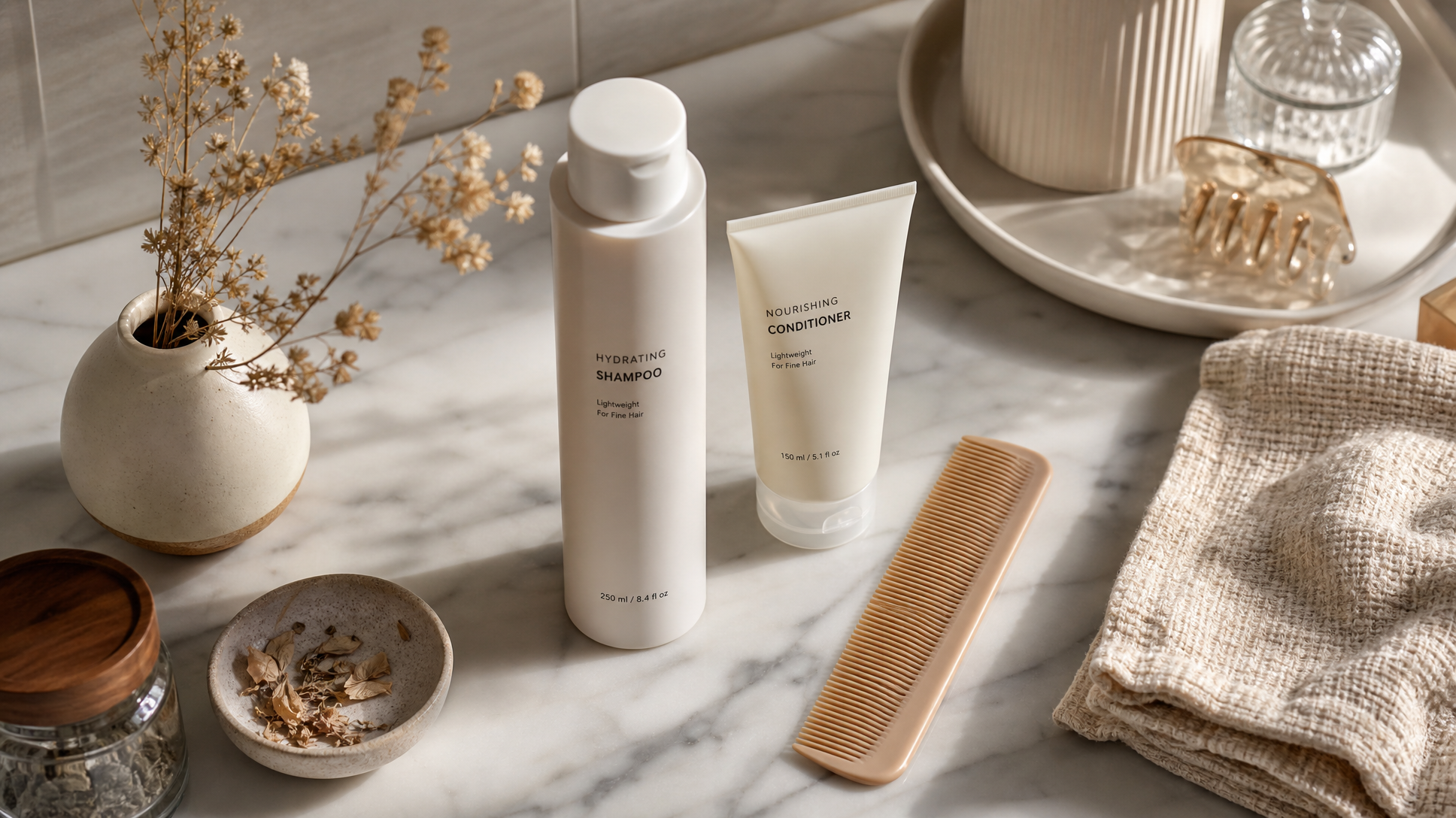
Browse the full hair care range at FeelForever21 — lightweight shampoos, targeted conditioners, and styling essentials, all with free shipping across the USA. Use code WELCOME5 for 5% off your first order.
Frequently Asked Questions
How often should I wash fine hair?
There's no universal answer, but most people with fine hair find that washing every other day or every two days works well — often better than stretching it out longer. Fine strands show oil and product buildup quickly, so waiting too long can actually make hair look flatter, not fresher. Pay attention to your scalp rather than following a fixed schedule.
Is it okay to use a hair mask if I have fine hair?
Occasionally, yes — but with restraint. Apply a mask only to the last inch or two of your ends, not the roots or mid-shaft, and don't leave it on longer than necessary. Rinse very thoroughly. Heavy masks used too often or applied too close to the roots are one of the main reasons fine hair loses volume.
Why does my fine hair go flat so quickly after washing?
Usually it comes down to one of three things: conditioner applied too close to the roots, too many products layered on at once, or a shampoo that isn't cleaning the scalp thoroughly enough. Start by pulling your conditioner application down to mid-shaft only and reducing the number of styling products you use — that alone makes a noticeable difference for most people.
Can fine hair be damaged? It seems too fragile to treat aggressively.
Yes — fine hair is actually more susceptible to breakage and heat damage than coarser hair types because each strand has less structural mass. This doesn't mean you need to avoid heat tools entirely, but it does mean using a heat protectant every time, keeping temperatures moderate, and avoiding repeated passes with hot tools over the same section. Gentle handling when hair is wet matters too, since strands are at their weakest when saturated.